 |
King Bladud |
 |
| Home Media King Bladud Sponsors Artists Inspiration Team Pigs Auction Links Contact |
The Legend
The year is 863BC. Bladud, King of the Britons and father of the
unfortunate King Lear who was immortalised by Shakespeare, had
spent much of his youth studying in Athens where he contracted
leprosy.
Returning home and realising that an imperfect prince could not inherit the throne, he left the royal palace in disguise to take a job as a swineherd in an "untravell'd part of the country".
This was certainly the Avon Valley, and may well have been the area we know today as Keynsham - remembering that this was more than 1,000 years before the Romans built villas in Keynsham and a full 1,500 years before the Saxons came to Bath.
As Bladud drove his pigs in search of acorns he crossed the River
Avon at shallows north of Saltford - at a place which subsequently
took its name from the legend - Swineford.
The rest of the story is famous. Bladud's pigs also contracted his disease but were cured when they rolled in the hot mud around Bath's springs.
Observing the miracle, Bladud also bathed in the hot murky water
and he too was cured.
Returning home in triumph he went on to become King. In gratitude
for his cure, Bladud founded a city at Bath and dedicated its
curative powers to the Celtic goddess Sul and 900 years later
the Romans called the city Aquae Sulis - the Waters of Sul.
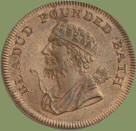
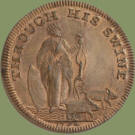
 Coins like the ones above (click coins to see larger image) are in
the archives of the Roman Baths ñ they are farthing-size. There
is also an interesting display of Bladud images in a side room
of the Pump Room.
Coins like the ones above (click coins to see larger image) are in
the archives of the Roman Baths ñ they are farthing-size. There
is also an interesting display of Bladud images in a side room
of the Pump Room.
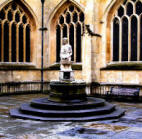
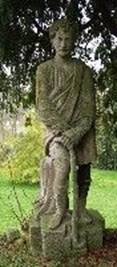
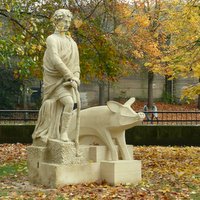
 There is a life-size stone statue of King Bladud - see picture on
right - in storage in the Council's care. It is finally to be placed
on public display again - in Parade Gardens. And next to it, one of
our pigs, carved out of Bath Stone! This is due to happen in Open
Heritage Week, at Half Term at the end of October 2009.
There is a life-size stone statue of King Bladud - see picture on
right - in storage in the Council's care. It is finally to be placed
on public display again - in Parade Gardens. And next to it, one of
our pigs, carved out of Bath Stone! This is due to happen in Open
Heritage Week, at Half Term at the end of October 2009.
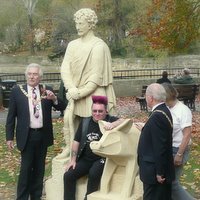
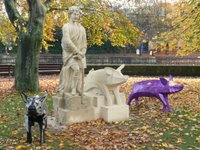
Update: We did it! King Bladud's now in
Parade Gardens -
and our pig next to him!
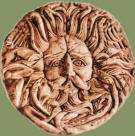 A
wonderful book by Moyra Caldecott ñ The Winged Man ñ early
in 2008. It's a fictional account of what Bladud's
life might have been like, based on thorough research of those
times and other works. It has this well-known face from the
Roman Baths on the cover ñ which many people believe also pictures
Bladud.
A
wonderful book by Moyra Caldecott ñ The Winged Man ñ early
in 2008. It's a fictional account of what Bladud's
life might have been like, based on thorough research of those
times and other works. It has this well-known face from the
Roman Baths on the cover ñ which many people believe also pictures
Bladud.
Many places in Bath are named after Bladud ñ there's for example Bladud Buildings, just off Broad Street, and the Bladud's Head, a pub in Larkhall.